Skip to main content
Contents Calc Dark Mode Prev Up Next \(\newcommand{\N}{\mathbb N}
\newcommand{\Z}{\mathbb Z}
\newcommand{\Q}{\mathbb Q}
\newcommand{\R}{\mathbb R}
\newcommand{\lt}{<}
\newcommand{\gt}{>}
\newcommand{\amp}{&}
\definecolor{fillinmathshade}{gray}{0.9}
\newcommand{\fillinmath}[1]{\mathchoice{\colorbox{fillinmathshade}{$\displaystyle \phantom{\,#1\,}$}}{\colorbox{fillinmathshade}{$\textstyle \phantom{\,#1\,}$}}{\colorbox{fillinmathshade}{$\scriptstyle \phantom{\,#1\,}$}}{\colorbox{fillinmathshade}{$\scriptscriptstyle\phantom{\,#1\,}$}}}
\)
Section 5.3 The Unit Circle
In this section, we will find function values for the sine and cosine of 30°, 45 °, and 60°, identify the domain and range of sine and cosine functions, find reference angles, and use reference angles to evaluate trigonometric functions.
Subsection Textbook Reference
Exercises Preparation Exercises
Answer the following without using a calculator. These questions are intended to check the prerequisite skills needed to complete the rest of the lab.
1. For a right triangle with side
\(\alpha = \frac{1}{2}\) and hypotenuse
\(c=1\text{,}\) find the missing side
\(b\) using the Pythagorean Theorem.
2.
Which quadrant are the following angles in?
(a) (b) (c) (d) (e) (f) (g) (h) 3. Simplify
\(2\pi - \frac{2\pi}{3}\) without a calculator.
4. Count from
\(0\) to
\(2\pi\) by multiples of
\(\frac{\pi}{12}\text{,}\) then reduce those fractions. Here’s how to start out:
\(\frac{0\pi}{12}, \frac{\pi}{12}, \frac{2\pi}{12}, \frac{3\pi}{12},...\)
Exercises Practice Exercises
1. (a) If
\(\cos(\theta)=\frac{1}{5}\) and
\(\sin(\theta) = -\frac{2\sqrt{5}}{5}\text{,}\) which quadrant must
\(\theta\) be in?
(b) If
\(\cos(\phi)=-\frac{2}{3}\) and
\(\sin(\phi) = \frac{\sqrt{5}}{3}\text{,}\) which quadrant must
\(\phi\) be in?
2.
Find the reference angles for the given angles.
(a) (b) (c) (d) 3.
Which of the standard angles between
\(0\) and
\(2\pi\) on the unit circle do the following
\(x\) and
\(y\) coordinates go with?
(a)
\(\left(\frac{1}{2},\frac{\sqrt{3}}{2}\right)\)
(b)
\(\left(\frac{-\sqrt{2}}{2},\frac{\sqrt{2}}{2}\right)\)
(c)
\(\left(\frac{\sqrt{3}}{2},-\frac{1}{2}\right)\)
4. (a) If
\(\cos(\theta)=\frac{1}{5}\) and
\(0 \leq \theta \leq \frac{\pi}{2}\text{,}\) find the value of
\(\sin(\theta)\text{.}\)
(b) If
\(\sin(\alpha)=-\frac{3}{7}\) and
\(\pi \leq \alpha\leq \frac{3\pi}{2}\text{,}\) find the value of
\(\cos(\alpha)\text{.}\)
(c) If
\(\cos(\beta)=-\frac{3}{4}\) and
\(\frac{\pi}{2} \leq \beta \leq \pi\text{,}\) find the value of
\(\sin(\beta)\text{.}\)
(d)
\(\cos(\frac{15\pi}{6})\)
5.
Evaluate the expressions without a calculator by first finding and using the reference angles for the angles shown.
(a) (b) (c)
\(\cos(\frac{11\pi}{4})\)
(d)
\(\cos(\frac{15\pi}{6})\)
Subsection Definitions
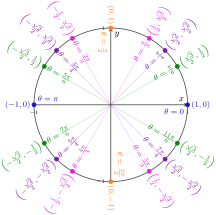
Figure 5.3.1.
Definition 5.3.2 . The Unit Circle.
A
unit circle is a circle with radius 1.
Definition 5.3.3 . Cosine of an Angle.
The
cosine of an angle ,
\(\theta\text{,}\) is equal to the
\(x\) -value at that angle on a unit circle.
Definition 5.3.4 . Sine of an Angle.
The
sine of an angle ,
\(\theta\text{,}\) is equal to the
\(y\) -value at that angle on a unit circle.
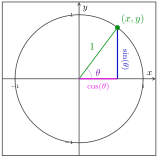
Definition 5.3.5 . The Pythagorean Identity.
The
Pythagorean Identity is the relationship between sine and cosine values,
\(\sin^2(\theta) + \cos^2(\theta) = 1\text{,}\) relating to the Pythagorean Theorem in
Figure 5.3.6 .
Figure 5.3.6.
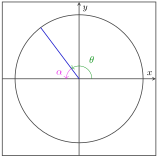
Definition 5.3.7 . Reference Angle.
A
reference angle ,
\(\alpha\text{,}\) to an angle
\(\theta\text{,}\) is the acute (or right) positive angle between the
\(x\) -axis to the angle
\(\theta\) as shown in
Figure 5.3.8 .
Figure 5.3.8.
Exercises Exit Exercises
1. Which angle,
\(\theta\text{,}\) between
\(0\) and
\(2\pi\) has a sine value of
\(-\frac{\sqrt{3}}{2}\) and a cosine value of
\(\frac{1}{2}\text{?}\)
2. What is the reference angle for
\(\frac{7\pi}{6}\text{?}\)
3. Evaluate
\(\sin(\frac{11\pi}{3})\) without a calculator.
4. If
\(\sin(\theta)=-\frac{1}{4}\) and
\(\pi \leq \theta \leq \frac{3\pi}{2}\text{,}\) find the value of
\(\cos(\theta)\text{.}\)
Reflection Reflection
1. On a scale of 1-5, how are you feeling with the concepts related to the graphical behaviors of functions?