Skip to main content
Contents Calc Dark Mode Prev Up Next \(\newcommand{\N}{\mathbb N}
\newcommand{\Z}{\mathbb Z}
\newcommand{\Q}{\mathbb Q}
\newcommand{\R}{\mathbb R}
\newcommand{\lt}{<}
\newcommand{\gt}{>}
\newcommand{\amp}{&}
\definecolor{fillinmathshade}{gray}{0.9}
\newcommand{\fillinmath}[1]{\mathchoice{\colorbox{fillinmathshade}{$\displaystyle \phantom{\,#1\,}$}}{\colorbox{fillinmathshade}{$\textstyle \phantom{\,#1\,}$}}{\colorbox{fillinmathshade}{$\scriptstyle \phantom{\,#1\,}$}}{\colorbox{fillinmathshade}{$\scriptscriptstyle\phantom{\,#1\,}$}}}
\)
Section 7.2 Trigonometric Identities
In this section, we will learn to verify the fundamental trigonometric identities and to simplify trigonometric expressions using algebra and the identities.
Subsection Textbook Reference
Exercises Preparation Exercises
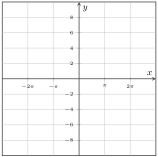
1. Sketch a graph of
\(f(x) = 4\sin\left(\frac{\pi}{3}\left(x-2\right)\right)+x\text{.}\)
2. If
\(g(x) = \frac{x-4}{x-1}\text{,}\) evaluate
\(g\left(\frac{x-2}{x-3}\right)\) and simplify to lowest form.
3. Which of the six fundamental trigonometric functions are odd functions?
4. True or false: "Since we know that
\(\sin^2(x) + \cos^2(x) = 1\text{,}\) then if we take the square root on both sides, it must be true that
\(\sin(x)+\cos(x)=1\text{.}\) "
5. Factor the expression
\(1-S^2\text{.}\)
Exercises Practice Exercises
1.
Use technology to verify the identity \(sec(x)−cos(x) = sin(x)tan(x)\) by following the steps below.
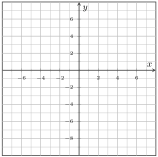
Make a graph of the left-hand side of the equation, \(y = \sec(x) - \cos(x)\text{,}\) using technology.
Make a graph of the right-hand side of the equation, \(y = \sin(x)\tan(x)\text{,}\) using technology.
Describe what you see on your graph. If the two graphs above overlap, then that verifies that both sides of the equation are identical.
2. Show that
\(\sin(x)-\cos(x)=\left(\tan(x)-1\right)\sec^2(x)\) is
not an identity by creating a graph in Desmos. Discuss with your neighbor what the graph shows that makes it not an identity.
3.
Verify the trigonometric identities.
(a)
\(\tan(\theta)\csc(\theta)=\sec(\theta)\)
(b)
\(\sec(-\beta) + \tan(-\beta) = (1-\sin(\beta))\sec(\beta)\) jj
(c)
\(\frac{\sec(\alpha)}{\csc(\alpha)} = \tan(\alpha)\)
(d)
\(\frac{\tan^2(\gamma)}{\tan^2(\gamma)+1} = \sin^2(\gamma)\)
(e)
\(\tan(\phi)\sin(\phi)+\cos(\phi)=\sec(\phi)\)
(f)
\(\frac{\csc(\mu)\cos(\mu)}{\tan(\mu)+\cot(\mu)} = \cos^2(\mu)\)
4.
Factor the trigonometric expressions.
(a) (b)
Subsection Definitions
Definition 7.2.1 . Identity.
An
identity is an equation that is always true, regardless of the value inputted.
Definition 7.2.2 . Identities for tangent, cotangent, secant, and cosecant.
Recall that the functions tangent , cotangent , secant , and cosecant can all be written in terms of sine and/or cosine.
\(\displaystyle \tan(x) = \frac{\sin(x)}{\cos(x)}\)
\(\displaystyle \sec(x) = \frac{1}{\cos(x)}\)
\(\displaystyle \cot(x) = \frac{\cos(x)}{\sin(x)}\)
\(\displaystyle \csc(x) = \frac{1}{\sin(x)}\)
Definition 7.2.3 . Odd and even trigonometric functions.
Recall that sine, tangent, cotangent, and cosecant are all odd functions .
\(\displaystyle \sin(x) = -\sin(x)\)
\(\displaystyle \tan(x) = -\tan(x)\)
\(\displaystyle \cot(x) = -\cot(x)\)
\(\displaystyle \csc(x) = -\csc(x)\)
Cosine and secant are even functions
Definition 7.2.4 . Pythagorean identities.
Recall the three Pythagorean Identities :
\(\displaystyle \sin^2(\theta) + \cos^2(\theta) = 1\)
\(\displaystyle \tan^2(\theta) + 1 = \sec^2(\theta)\)
\(\displaystyle \cot^2(\theta) + 1 = \csc^2(\theta)\)
Note that the first relationship is often written as either
\(\sin^2(\theta) = 1 - \cos^2(\theta)\) or
\(\cos^2(\theta) = 1 - \sin^2(\theta)\text{.}\)
Exercises Exit Exercises
1. What makes an equation "an identity"?
2.
How would you decide if the equation
\begin{equation*}
\sin(\theta)+\cos(\theta) = \frac{1}{\csc(\theta)+\sec(\theta)}
\end{equation*}
is an identity or not?
3.
Verify the identity
\begin{equation*}
-\frac{\cos(-\kappa)}{\sec(\kappa)} = \sin^2(\kappa) - 1\text{.}
\end{equation*}
4.
Verify the identity
\begin{equation*}
-\frac{\cos(x)}{1 - \sin(x)} = \frac{1+\sin(x)}{\cos(x)}\text{.}
\end{equation*}
Reflection Reflection
1. On a scale of 1-5, how are you feeling with the concepts related to the graphical behaviors of functions?