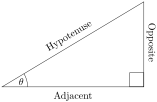
In this section, we will use right triangles to evaluate trigonometric functions, find function values for 30°, 45°, and 60°, use all six trigonometric functions to find lengths inside right triangles, and use right-triangle trigonometry to solve applied problems.
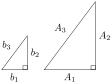
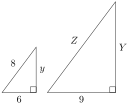
Recall that similar triangles are two triangles with equal angle measurements, but not necessarily equal side lengths. The ratio of any two corresponding sides of the triangles will be equal, which means that
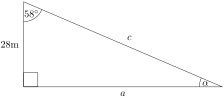
For the triangle shown in Figure 5.2.5, find \(a\text{,}\)\(c\text{,}\) and \(\alpha\text{.}\) You can use a calculator to help get an approximation, accurate to 4 digits behind the decimal place.
A right triangle with hypotenuse \(c\text{,}\) a side with length \(a\) adjacent to angle \(\alpha\text{,}\) and a side with length \(28\)m adjacent to an angle with measure \(58^\circ\text{.}\)
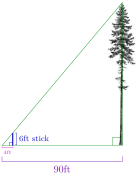
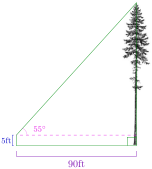
On a backpacking trip in the Wallowa Mountains of northeastern Oregon, Megan and Emily were marveling at the height of an enormous Ponderosa Pine. Ross said, "we can calculate it’s height pretty easily just by knowing that ’a pace’ is 3ft and the distance from the tip of my thumb to the tip of my pinkie is 9 inches". Ross paced away from the tree on level ground 30 paces. Help the three hikers measure the height of the tree two different ways.
Ross finds a stick and measures it to be about 6ft tall. He lays down on the ground and asks Emily to hold the stick vertically on the ground at a certain point where the tip of the stick lines up with the tip of the tree from his point of view. That distance on the ground was 4ft from Ross’s viewing position, as shown in Figure 5.2.6. Set up similar triangles to estimate the height of the tree. Drawing not to scale.
Ross then took out his phone and used the inclinometer app on to measure the angle to to top of the tree, to be about 55°. In this scenario, Ross still 30 paces away from the tree, and was standing to measure the height: the phone was 5ft above the ground, as shown in Figure 5.2.7. Use right-triangle trigonometry to estimate the height of the tree. Drawing not to scale.
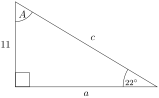
Shown in Figure 5.2.12 is a triangle with side \(b=11\text{,}\) angle \(B = 22^\circ\text{,}\) and angle \(C = 90^\circ\text{.}\) Find the length of the side \(a\text{.}\)