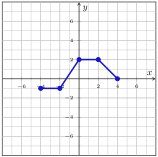
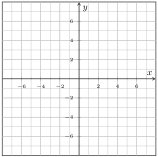
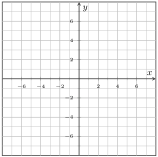
Imagine a function \(y = h(x)\text{,}\) with some points given in the table below. Fill in the table to show how the points are transformed for the given function values.
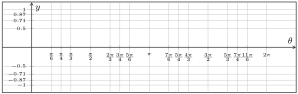
Make a graph of \(y = sin(x)\) by plotting the points that you know from the table. You need to know that \(\frac{\sqrt{2}}{2} \approx 0.71\) and \(\frac{\sqrt{3}}{2} \approx 0.87\text{.}\)
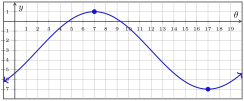
Make a graph of \(T\) with what you know about the shape of \(\sin(x)\) and the information that you gained in the above parts. Check your result on a calculator after you’ve tried everything by hand.
Definition6.1.3.Even/Odd Function Properties of Sine and Cosine.
Sine is an odd function, which means that it is symmetrical over the origin. Cosine is an even function, which means that it is symmetrical over the \(y\)-axis.
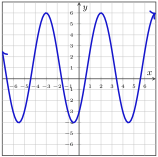
The period of a function is the smallest number, \(P\text{,}\) such that a horizontal shift of \(P\) units results in a graph that perfectly overlaps the graph of the original function. Try this Desmos link to see a visual on the topic.
The midline of a periodic function is the horizontal line, \(y= D\text{,}\) that is exactly halfway between the highest and lowest \(y\)-values on the graph. You can find this equation by averaging the highest and lowest \(y\)-values on the graph with the formula \(y= \frac{\text{highest y-value } + \text{lowest y-value}}{2}\text{.}\)
The amplitude of a periodic function is the vertical distance from the midline to the highest \(y\)-value on the graph or the vertical distance from the midline to the lowest \(y\)-value on the graph. You can find this distance with the formula \(|A|= \frac{\text{highest y-value } - \text{lowest y-value}}{2}\text{.}\)
A sinusoidal function is a transformation of a sine or cosine function. Sinusoidal functions have the form \(f(x) = Asin(B(x−C)) + D\) or \(f(x) = Acos(B(x−C)) + D\text{.}\)
The phase shift of a periodic function represents the fraction of a period that the graph has been shifted from the base function. You can find the phase shift of a sinusoidal function (\(f(x) = Asin(B(x−C)) + D\) or \(f(x) = Acos(B(x−C)) + D\)) by evaluating \(\frac{BC}{2\pi}\text{.}\) Please note that this definition is different from the one that the book gives, but is consistent with most other physics, engineering, and technical mathematics texts. The book defines the phase shift to be the same as the horizontal shift, for which we already have a name.
A sinusoidal function, \(f(x) = Asin(B(x−C)) + D\) or \(f(x) = Acos(B(x−C)) + D\text{,}\) is horizontally shifted C units from the base function position.
Definition6.1.10.Relationship between the B-value and the Period.
The B value of a sinusoidal function, \(f(x) = Asin(B(x−C)) + D\) or \(f(x) = Acos(B(x−C)) + D\text{,}\) has a relationship with the period, \(P\text{,}\) of the function. Since the period is a positive number, we will use absolute values on B, since B might be negative. That relationship is that \(|B|=\frac{2\pi}{P}\text{,}\) which is the same as saying \(P = \frac{2\pi}{|B|}\text{.}\)