In this section, we will learn about complex numbers. We will learn how to plot complex numbers in the complex plane, convert complex numbers between polar, rectangular, and Euler forms, and how to arithmetic with complex numbers.
Convert the rectangular point \(\left(-5,2\right)_r\) to polar form. Use your calculator to find an angle in radians rounded to two digits behind the decimal place.
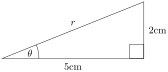
For the right triangle shown in Figure 8.3.1, find the missing length of \(r\) and the missing angle \(\theta\) using SOHCAHTOA. You can ue a calculator to get an approximation, accurate to 4 digits behind the decimal place.
Convert the polar form complex number \(7\left(\cos\left(\frac{5\pi}{6}\right) + i\sin\left(\frac{5\pi}{6}\right)\right)\) into standard form. Keep your values exact using your memorized values on the unit circle.
Convert the Euler’s form complex number \(7e^{\frac{4\pi i}{3}}\) into standard form. Keep your values exact using your memorized values on the unit circle.
The imaginary unit \(i\) is defined to be \(i=\sqrt{-1}\text{.}\) Since there is no real number that is multiplied by itself to create a negative number, \(i\) must not be a real number. It fits into a new category of numbers called imaginary numbers, which are multiples of \(i\text{.}\) It’s called a "unit" because its absolute value is \(1\)
Definition8.3.4.Standard Form of a Complex Number.
A complex number is any real number plus any imaginary number. Any complex number can be written in standard form (also called rectangular form), which is the form \(a+bi\text{,}\) where both \(a\) and \(b\) are real numbers.
The complex plane is the two dimensional axes system to pot complex numbers. The horizontal axis, often just labeled \(x\text{,}\) measures the real part of a complex number. The vertical axis, often labeled \(y\text{,}\) measures the imaginary part of a complex number.
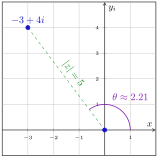
The number \(-3+4i\) would be plotted \(3\) units to the left and \(4\) units up from the origin at the same place that \((-3,4)\) would have been plotted in the regular two-dimensional real axes.
Definition8.3.8.Absolute Value of a Complex Number.
The absolute value of the complex number is the distance from the origin to the number in the complex plane. The absolute value is written as usual, \(|z|\text{.}\) To find the absolute value of \(z= a+ bi\text{,}\) use the Pythagorean Theorem: \(|z|= \sqrt{a^2 + b^2}\text{.}\)
The argument of the complex number, \(z =a+ bi\text{,}\) is an angle, \(\theta\text{,}\) measured from the standard position to the number in the complex plane. To find this angle, θ, use the formula \(tan(\theta) = \frac{b}{a}\) solve for \(\theta\) that is in the correct quadrant.
To find the argument of \(z =−3 + 4i\text{,}\) we would first note that \(z\) is in the second quadrant, and we would write \(tan(\theta) = \frac{4}{−3}\text{.}\) Next, we would take the inverse-tangent on both sides, however, inverse-tangent does not give us angles in quadrant II, so we know that to find the correct argument of \(z\) we should add \(\pi\text{.}\) So the argument of \(z\) is \(\theta = \tan^{-1}\left(\frac{4}{-3}\right) + \pi \approx 2.21\text{,}\) as shown in Figure 8.3.12
A graph on the complex plane. The point \(-3+4i\) is plotted with a dotted line connecting it to the origin. The dotted line is labeled \(|z| = 5\text{,}\) showing the absolute value, and the angle from the positive \(x\)-axis is labeled \(\theta \approx 2.21\text{,}\) showing the argument.
A complex number can be written in polar form, which is the form \(r\left(\cos(\theta)+i\sin(\theta)\right)\text{,}\) where \(r=|z|\) and \(\theta\) is the argument of the complex number.
Find the absolute value of the complex number \(-6-4i\text{.}\) Simplify the radical completely and leave your answer in exact form. Illustrate the value on your plot from exercise a.
Find the argument of the complex number \(-6-4i\text{.}\) Use a calculator to round your answer to three digits behind the decimal place. Illustrate the value on your plot from exercise a.