In this section, we’ll find exact values of the trigonometric functions secant, cosecant, tangent, and cotangent of \(\frac{\pi}{3}\text{,}\)\(\frac{\pi}{4}\text{,}\) and \(\frac{\pi}{3}\text{,}\) use reference angles to evaluate the trigonometric functions secant, tangent, and cotangent, use properties of even and odd trigonometric functions, recognize and use fundamental identities, and evaluate trigonometric functions with a calculator.
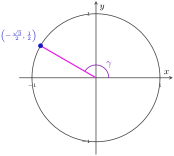
A unit circle with an angle \(\gamma\) in standard position, beginning on the positive \(x\)-axis and rotating counter-clockwise to the coordinates \((-\frac{\sqrt{3}}{2},\frac12)\) in the second quadrant.
Find all six trigonometric function values at the angle \(\frac{\pi}{3}\) using your memorized values for \(\sin\left(\frac{\pi}{3}\right)\) and \(\cos\left(\frac{\pi}{3}\right)\text{.}\)
Use the fact that \(\sin(x)\text{,}\)\(\tan(x)\text{,}\)\(\cot(x)\text{,}\) and \(\csc(x)\) are all odd, and \(\cos(x)\) and \(\sec(x)\) are even to find the following values.
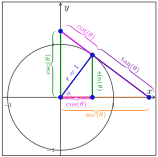
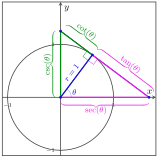
For a right triangle with angle \(\theta\text{,}\) the "other trig functions" can be found by the following definitions as in Figure 5.4.4. Visit this interactive Desmos graph to see the six trigonometric lengths in action.
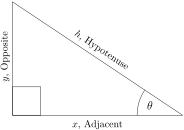
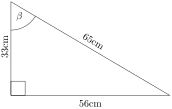
For a right triangle with hypotenuse \(h\text{,}\) and sides \(x\) and \(y\text{,}\) as in Figure 5.4.6, tangent is still "opposite over adjacent", as you saw in the section about right-angle trigonometry and the "other trigonmetric function values" can be found with "CHOSHACAO". Visit this interactive Desmos graph to see the six trigonometric lengths in action.
Definition5.4.7.Even and Odd Trigonometric Functions.
Recall that even functions are symmetrical about the \(y\)-axis, which makes \(f(x)=f(-x)\text{,}\) and odd functions are symmetrical about the origin, which makes \(-f(x) = f(-x)\text{.}\) All of the trigonometric functions are either even or odd. Here’s a list:
You already know that \(\sin^2(\theta) + \cos^2(\theta) = 1\text{,}\) and that this is called the Pythagorean Identity. There are two other Pythagorean relationships which you can see in Figure 5.4.9, which is a trimmed down version of Figure 5.4.4.
Definition5.4.10.Periods of Trigonometric Functions.
The period of a function is a length of the shortest \(x\)-interval over which a function completes one full cycle. This can be thought of as the shortest distance that a graph can be shifted left or right before completely aligning with the original graph. Mathematically, this would be that the period, \(P\text{,}\) of a repeating function \(f\) is the smallestvalue such that \(f(x+P) = f(x)\text{,}\) for any value of \(x\text{.}\)
The period of \(\sin(x)\text{,}\)\(\csc(x)\text{,}\)\(\cos(x)\text{,}\) and \(\sec(x)\) is \(2\pi\text{.}\)