Section 5.1 Angles

In this section, we’ll draw angles in standard position, convert between degrees and radians and degrees-minutes-seconds, find coterminal angles, and find the length of a circular arc.

Subsection Textbook Reference

This relates to content in Β§7.1 of Algebra and Trigonometry 2e.

Exercises Preparation Exercises

1.

Answer the following without using a calculator. These questions are intended to check the prerequisite skills needed to complete the rest of the lab.
(a)
Solve the equation \(T = \dfrac{v}{w^2}\) for \(w\text{.}\)
(b)
Simplify the expression \(80 \cdot \dfrac{\pi}{180}\) without a calculator. Reduce to simplest form.
(c)
In terms of time, how many minutes total are in 3 hours and 53 minutes?
(d)
Draw a line segment from the point \((5,-3)\) to the point \((-1,2)\text{.}\) Find the distance between those two points using the Pythagorean Theorem. Leave your answer in exact form.

Exercises Practice Exercises

1.

Find an angle that is coterminal to -40Β° and is between 360Β° and 720Β°

3.

Convert the angles.
(a)
Convert 28Β° to radians. Leave your answer as a fraction in terms of \(\pi\text{.}\)
(b)
Convert \(\dfrac{7\pi}{9}\) radians to degrees. Round to 6 digits behind the decimal place.
(c)
Convert 14Β°20β€²36β€³ to a decimal measurement of degrees.

4.

Use the formula \(s = r\theta\) to find the missing values.
(a)
Find the arc length of on a circle of radius 6 with an interior angle of \(\dfrac{4\pi}{7}\text{.}\)
(b)
Find the interior angle of an arc length on a circle of radius 12 with an arc length of \(\dfrac{3\pi}{2}\text{.}\)
(c)
Find the arc length of on a circle of radius \(10\pi\) with an interior angle of 20Β°

Subsection Definitions

Definition 5.1.1. Angle.

An angle is formed when two lines intersect at a point. We can measure the β€œsize” of this angle in degrees or radians.

Definition 5.1.2. Ray.

A ray is a portion of a line that starts at a point and extends infinitely in one direction.

Definition 5.1.3. Degree.

A degree is an angle measurement equal to \(\dfrac{1}{360}\) of a full rotation.

Definition 5.1.4. Right Angle.

A right angle is an angle of 90Β°.

Definition 5.1.5. Radian.

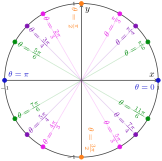
A radian is a unit of measurement of angle size, and 1 radian is defined to be the angle that is made when the arc length for that angle on a circle of radius 1 is equal to 1. Check out this Desmos link and click the "play" button on the slider for a visual representation of this concept.
described in detail following the image
A circle with common angles indicated in radians:
0Β° \(\theta = 0\)
30Β° \(\theta = \dfrac{\pi}{6}\)
45Β° \(\theta = \dfrac{\pi}{4}\)
60Β° \(\theta = \dfrac{\pi}{3}\)
90Β° \(\theta = \dfrac{\pi}{2}\)
120Β° \(\theta = \dfrac{2\pi}{3}\)
135Β° \(\theta = \dfrac{3\pi}{4}\)
150Β° \(\theta = \dfrac{5\pi}{6}\)
180Β° \(\theta = \pi\)
210Β° \(\theta = \dfrac{7\pi}{6}\)
225Β° \(\theta = \dfrac{5\pi}{4}\)
240Β° \(\theta = \dfrac{4\pi}{3}\)
270Β° \(\theta = \dfrac{3\pi}{2}\)
300Β° \(\theta = \dfrac{5\pi}{3}\)
315Β° \(\theta = \dfrac{7\pi}{4}\)
330Β° \(\theta = \dfrac{11\pi}{6}\)
Figure 5.1.6. Standard Angles

Definition 5.1.7. Initial and Terminal sides.

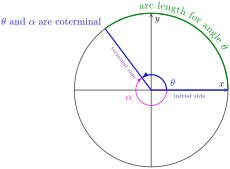
An angle is created by imagining two rays originating from the same point: the initial side of the angle is stationary and the terminal side is rotated around until the desired angle is created. Angles measured from initial to terminal side in a counterclockwise direction are positive. Angles measured from initial to terminal side clockwise are negative.

Definition 5.1.8. Standard Position.

An angle is said to be in standard position if the initial and terminal sides of the angle meet at the origin and the initial side of the angle is along the positive x-axis.

Definition 5.1.9. Coterminal.

Two angles are coterminal if their initial and terminal sides align, but they differ by an integer number of full rotations. In standard position, this means that the two angles are β€œin the same place” are different by some integer multiple of 360Β° (or \(2\pi\) radians).

Definition 5.1.10. Arc length.

An arc length is a distance along a part of the circumference of a circle. A formula for arc length is \(s = rΞΈ\text{,}\) where \(s\) stands for arc length along a circle of radius \(r\text{,}\) with an interior angle \(\theta\) centered at the center of the circle.
described in detail following the image
An angle drawn in standard position is indicated in two ways. Beginning with an initial side along the positive \(x\)-axis and ending with a terminal side in the second quadrant, the angle in the counter- clockwise direction is labeled \(theta\) and the angle in the clockwise direction is labeled \(alpha\text{.}\) The segment of the circumference of the circle between the initial and terminal sides of \(theta\) is the arc subtended by \(theta\text{,}\) and the length measure of that arc is the arc length for angle \(theta\text{.}\)
Figure 5.1.11. Coterminal angles \(\theta\) and \(\alpha\)

Exercises Exit Exercises

3.

Convert the angle 144Β° to radians. Write your answer in exact form as a fraction with \(\pi\) in it.

4.

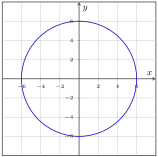
How big of an arc length will an angle of \(\dfrac{3\pi}{8}\) radians create on a circle of radius 6? Draw this angle and arc length on the circle of radius 6 provided.
described in detail following the image
A circle with radius 6, centered on the origin $(0,0)$.
Figure 5.1.12. A circle of radius 6

Reflection Reflection

1.

On a scale of 1–5, how are you feeling with the concepts related to the graphical behaviors of functions?