Section 6.3 Inverse Trigonometry

In this section, we’ll use the inverse sine, cosine, and tangent functions, find the exact value of expressions involving the inverse-trigonometric functions, use a calculator to evaluate inverse-trigonometric functions, and find the exact values of composite functions with inverse-trigonometric functions.

Subsection Textbook Reference

This relates to content in Β§8.3 of Algebra and Trigonometry 2e.

Exercises Preparation Exercises

Answer the following without using a calculator. These questions are intended to check the prerequisite skills needed to complete the rest of the lab.

1.

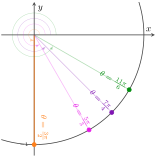
Fill in the blanks referring to the angles in FigureΒ 6.3.1.
described in detail following the image
Quadrant IV of a unit circle. The angles
  • \(\displaystyle \frac{11\pi}{6}\)
  • \(\displaystyle \frac{7\pi}{4}\)
  • \(\displaystyle \frac{5\pi}{3}\)
  • \(\displaystyle \frac{3\pi}{2}\)
are indicated.
Figure 6.3.1. Unit Circle with Standard Values
(a)
\(\frac{11\pi}{6}\) is coterminal with the negative angle \(\rule{1cm}{0.15mm}\)
(b)
\(\frac{7\pi}{4}\) is coterminal with the negative angle \(\rule{1cm}{0.15mm}\)
(c)
\(\frac{5\pi}{3}\) is coterminal with the negative angle \(\rule{1cm}{0.15mm}\)
(d)
\(\frac{3\pi}{2}\) is coterminal with the negative angle \(\rule{1cm}{0.15mm}\)

2.

The invertible function \(g\) is defined by TableΒ 6.3.2. Fill in the \(g^{-1}(x)\) row. Some entries may be "undefined".
\(x\) \(-4\) \(-1\) \(1\) \(3\) \(6\) \(10\) \(11\)
\(g(x)\) \(10\) \(3\) \(6\) \(-4\) \(9\) \(-1\) \(1\)
\(g^{-1}(x)\) \(\quad\) \(\quad\) \(\quad\) \(\quad\) \(\quad\) \(\quad\) \(\quad\)
Table 6.3.2. The invertible function \(g\)

3.

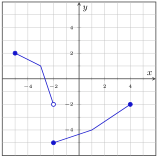
Show that the graph in FigureΒ 6.3.3 represents an invertible function \(y=R(x)\text{.}\) Graph the inverse \(y = R^{-1}(x)\) alongside \(y=R(x)\text{.}\)
described in detail following the image
A graph of a piecewise function, defined as:
  • \(y=-\frac{1}{2}(x-1)\) on the interval \([-5,-3)\text{,}\)
  • \(y=-3x-8\) on the interval \([-3,-2)\text{,}\)
  • \(y=\frac{1}{3}(x-13)\) on the interval \([-2,1)\text{,}\)
  • \(y=\frac{2}{3}(x-7)\) on the interval \([1,4]\text{.}\)
Figure 6.3.3. Graph of \(y=R(x)\)

Exercises Practice Exercises

2.

Fill in TableΒ 6.3.4 using your memorized values on the unit circle.
Table 6.3.4. Table for Practice 2
\(t\) \(\quad 1 \quad\) \(\,\,\frac{\sqrt{3}}{2}\,\,\) \(\,\,\frac{\sqrt{2}}{2}\,\,\) \(\quad \frac{1}{2} \quad\) \(\quad 0 \quad\) \(\,-\frac{1}{2}\,\) \(-\frac{\sqrt{2}}{2}\) \(-\frac{\sqrt{3}}{2}\) \(\,\,-1\,\,\)
\(\cos^{-1}(t)\)
\(\sin^{-1}(t)\)

3.

Fill in TableΒ 6.3.5 with standard values of inverse trigonmetric functions without a calculator. If the value of \(z\) is blank, start by filling that in first.
\(\, z \,\) \(\sin^{-1}(z)\) \(\cos^{-1}(z)\) \(\tan^{-1}(z)\)
\(0\)
\(-\frac{\pi}{2}\)
\(\frac{\pi}{6}\) N/A
\(\frac{\pi}{4}\)
\(\frac{\sqrt{2}}{2}\) N/A
\(\frac{2\pi}{3}\) N/A
Table 6.3.5. Table for Practice 3

5.

Use inverse trigonometry to find the missing angles.
(a)
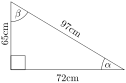
Use inverse trigonometry and a calculator to find the missing angles \(\alpha\) and \(\beta\) in the triangle shown in FigureΒ 6.3.6. Drawing not to scale.
described in detail following the image
A right triangle with hypotenuse 97cm, angle \(\alpha\) adjacent to length 72cm, and angle \(\beta\) adjacent to side 65cm.
Figure 6.3.6. A right triangle
(b)
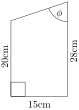
Imagine designing a birdhouse to make out of wood. The sides of this birdhouse are shaped like trapezoids, with dimensions shown in FigureΒ 6.3.7. Find the angle \(\phi\text{,}\) in degrees, using inverse trigonometry and your calculator. Note: this angle will be related to how you set up your saw to cut the wood correctly.
described in detail following the image
A trapezoid showing the side profile of a birdhouse. The base is of length 15cm, the sides are at right angles to the base, the short side is length 20cm, and the long side is length 28cm. The top is of unknown length, but meets the long side at an angle labeled \(\phi\text{.}\)
Figure 6.3.7. The side of a birdhouse

8.

In this exercise, discuss some of the details about inverse trigonometry with your group members.
(a)
What are the similarities and differences between \(\sin^{-1}(x)\) and \(\csc(x)\text{?}\) Start by discussing the meaning of the inputs and outputs of the functions.
(b)
What are the similarities and differences between \(\sin^{-1}(x)\) and \(\sin^2(x)\text{?}\) Start by discussing the meaning of the inputs and outputs of the functions.
(c)
The range of both \(\sin^{-1}(x)\) and \(\tan^{-1}(x)\) is in quadrants I and IV. The range of \(\cos^{-1}(x)\) is in quadrants I and II. Why do you think that none of the inverse trigonometric functions using quadrant III?
(d)
If Georgiana said that, "I think that the value of \(\sin^{-1}(-1)\) is \(\frac{3\pi}{2}\text{,}\)" how would you help her understand her mistake?

Subsection Definitions

Definition 6.3.8. Inverse Cosine.

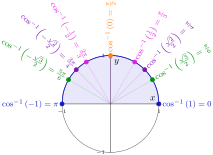
The inverse cosine function inputs an \(x\)-value on the unit circle and outputs the angle from \(0\) to \(\pi\) that matches that \(x\)-value, as shown in FigureΒ 6.3.10. Another way to say that is that for angles, \(\theta\text{,}\) in the interval \([0,\pi]\text{,}\) if \(\cos(\theta) = x\) then \(\cos^{-1}(x) = \theta\text{.}\)
Function \(\sin\left(z\right)\) \(\sin^{-1}\left(z\right)\)
Domain and meaning \(\mathbb{R}\) except odd multiples of \(\frac{\pi}{2}\)
Angles on unit circle
\([-1,1]\)
\(x\)-values on unit circle
Range and meaning \([-1,1]\)
\(x\)-values on unit circle
\(\left[0,\pi\right]\)
Angles on unit circle
Table 6.3.9. Domain and range for cosine and cosine inverse
described in detail following the image
A unit circle with the values in quadrants I and II, where \(y\) is positive and \(\theta\) is between \(0\) and \(\pi\text{,}\) are indicated.
Figure 6.3.10. Unit Circle with Standard Inverse Cosine Values

Definition 6.3.11. Inverse Sine.

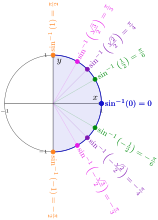
The inverse sine function inputs a \(y\)-value on the unit circle and outputs the angle from \(-\frac{\pi}{2}\) to \(\frac{\pi}{2}\) that matches that \(x\)-value, as shown in FigureΒ 6.3.13. Another way to say that is that for angles, \(\theta\text{,}\) in the interval \([-\frac{\pi}{2},\frac{\pi}{2}]\text{,}\) if \(\sin(\theta) = y\) then \(\sin^{-1}(y) = \theta\text{.}\)
Function \(\sin\left(z\right)\) \(\sin^{-1}\left(z\right)\)
Domain and meaning \(\mathbb{R}\) except odd multiples of \(\frac{\pi}{2}\)
Angles on unit circle
\([-1,1]\)
\(y\)-values on unit circle
Range and meaning \([-1,1]\)
\(y\)-values on unit circle
\(\left[-\frac{\pi}{2},\frac{\pi}{2}\right]\)
Angles on unit circle
Table 6.3.12. Domain and range for sine and sine inverse
described in detail following the image
A unit circle with the values in quadrants IV and II, where \(x\) is positive and \(\theta\) is between \(-\frac{\pi}{2}\) and \(\frac{\pi}{2}\text{,}\) are indicated.
Figure 6.3.13. Unit Circle with Standard Inverse Sine Values

Definition 6.3.14. Inverse Tangent.

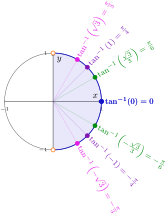
The inverse tangent function inputs a slope, \(m\text{,}\) and ouptuts the angle from \(-\frac{\pi}{2}\) to \(\frac{\pi}{2}\) (non-inclusive) that matches that slope, as shown in FigureΒ 6.3.16. Another way to say that is that for angles, \(\theta\text{,}\) in the interval \([-\frac{\pi}{2},\frac{\pi}{2}]\text{,}\) if \(\tan(\theta) = m\) then \(\tan^{-1}(m) = \theta\text{.}\)
Function \(\tan\left(z\right)\) \(\tan^{-1}\left(z\right)\)
Domain and meaning \(\mathbb{R}\) except odd multiples of \(\frac{\pi}{2}\)
Angles on unit circle
\(\mathbb{R}\)
Slopes
Range and meaning \(\mathbb{R}\)
Slopes
\(\left(-\frac{\pi}{2},\frac{\pi}{2}\right)\)
Angles on unit circle
Table 6.3.15. Domain and range for tangent and tangent inverse
described in detail following the image
A unit circle with the values in quadrants I and II, where \(x\) is positive and \(\theta\) is between \(-\frac{\pi}{2}\) and \(\frac{\pi}{2}\text{,}\) are indicated.
Figure 6.3.16. Unit Circle with Standard Inverse Tangent Values

Exercises Exit Exercises

1.

Fill in the blanks to show how you should think about the inputs and outputs of each function? The answer to each is either "an angle", "an \(x\)-value on the unit circle", or "\(y\)-value on the unit circle".
(a)
\(\rule{3cm}{0.15mm} = \sin\left(\rule{3cm}{0.15mm}\right)\)
(b)
\(\rule{3cm}{0.15mm} = \cos\left(\rule{3cm}{0.15mm}\right)\)
(c)
\(\rule{3cm}{0.15mm} = \sin^{-1}\left(\rule{3cm}{0.15mm}\right)\)
(d)
\(\rule{3cm}{0.15mm} = \cos^{-1}\left(\rule{3cm}{0.15mm}\right)\)

2.

Evaluate \(\cos^{-1}\left(\cos\left(\frac{5\pi}{4}\right)\right)\text{.}\)

3.

Fill in the missing values in TableΒ 6.3.17.
\(\quad z \quad\) \(\sin^{-1}\left(z\right)\) \(\cos^{-1}\left(z\right)\)
\(\qquad\) \(\qquad\) \(\frac{\pi}{3}\)
\(\qquad\) \(-\frac{\pi}{4}\) \(\qquad\)
\(\frac{-\sqrt{3}}{2}\) \(\qquad\) \(\qquad\)
Table 6.3.17. A table of invere trigonometry

4.

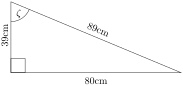
Use inverse trigonometry and a calculator to find the missing angle \(\zeta\) in the triangle shown in FigureΒ 6.3.18. Drawing is not to scale.
described in detail following the image
A right triangle with hypotenuse 89cm, unknown angle \(\zeta\text{,}\) adjacent side 39cm, and opposite side 80cm.
Figure 6.3.18. A right triangle

Reflection Reflection

1.

On a scale of 1-5, how are you feeling with the concepts related to the graphical behaviors of functions?