Carlos and Reba were having a discussion about the equation \(\sin(\theta)=\frac{1}{2}\text{.}\) The answers below are either "both Reba and Carlos are right", "only Reba is right", "only Carlos is right" or "neither Reba nor Carlos are right".
Reba said that \(-\frac{\pi}{6}\) was the same as \(\frac{11\pi}{6}\text{.}\) Carlos said that \(-\frac{\pi}{6}\) is not the same as \(\frac{11\pi}{6}\text{.}\) Who was right?
Reba said that the value of \(\sin^{-1}\left(\frac{1}{2}\right)\) was \(\frac{5\pi}{6}\text{.}\) Carlos said that the value of \(\sin^{-1}\left(\frac{1}{2}\right)\) was \(\frac{\pi}{6}\text{.}\) Who was right?
Reba said that thinking about the equation \(\sin(\theta)=\frac{1}{2}\) is the same as thinking about angles that have a \(y\)-value of \(\frac{1}{2}\text{.}\) Carlos said that thinking about the equation \(\sin(\theta)=\frac{1}{2}\) is the same as thinking about angles that have an \(x\)-value of \(\frac{1}{2}\text{.}\) Who was right?
Reba said there are two solutions to the equation \(\sin(\theta)=\frac{1}{2}\text{.}\) Carlos said that there are infinitely many solutions to the equation \(\sin(\theta)=\frac{1}{2}\text{.}\) Who was right?
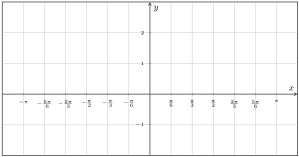
If you were trying to solve the equation \(2\sin^2(x) = \sin(x) + 1\) on the interval \([-\pi,pi]\text{,}\) and you had a graph of \(y = 2\sin^2(x)\) and \(y = \sin(x) + 1\text{,}\) what would you look for on the graph to solve the equation? Create that graph, then write out the solution set based on your work.
\(\sin(4\theta) - \sin(2\theta) = 0\) on the interval \(\left[-\pi,\pi\right]\) by first using the difference-to-product identity \(\sin(\alpha) - \sin(\beta) = 2\sin\left(\frac{\alpha - \beta}{2}\right) \cos\left(\frac{\alpha + \beta}{2}\right)\text{.}\)
Explain the solving process, in English, for the equation \(\cos(\theta) = \frac{1}{2}\) on the interval \(\left[-2\pi,2\pi\right]\) step by step as if you were explaining it to someone in your class who wanted to understand today’s lesson more deeply. Actually solving the equation isn’t necessary.