In this section, we will learn how to use the laws of sines and cosines to find missing sides and angles in non-right triangles. Then we can use these laws to solve applications.
Find solutions to the equation \(56\sin(\theta) = 21\) on the interval \(\left[-180^\circ,180^\circ\right]\text{.}\) Use your calculator and write your answer(s) rounded to four digits behind the decimal place.
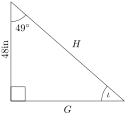
For the right triangle shown in Figure 8.1.1, find the missing lengths of \(G\text{,}\)\(H\text{,}\) and the angle \(\iota\text{.}\) You can use a calculator to hep get an approximation, accurate to four digits behind the decimal place.
A right triangle with unknown hypotenuse \(H\text{,}\) unknown angle \(\iota\) and adjacent side \(G\text{,}\) and known angle \(49^\circ\) with adjacent side length \(48\)in.
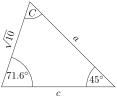
Find the missing angle, \(C\text{,}\) and then use the law of sines to find the missing lengths \(a\) and \(c\text{,}\) in the triangle in Figure 8.1.2. Round your answers to two digits behind the decimal place.
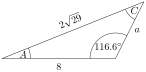
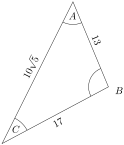
Use the law of sines to find the missing angles, \(A\) and \(C\text{,}\) and the length, \(a\text{,}\) in the triangle in Figure [provisional cross-reference: practice-laws-SSA]. Round your answers to two digits behind the decimal place.
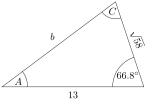
Use the law of cosines to find the missing angles, \(A\) and \(C\text{,}\) and the length, \(b\text{,}\) in the triangle in Figure [provisional cross-reference: practice-laws-SAS]. Round your answers to two digits behind the decimal place.
Use the law of cosines to find the missing angles, \(A\text{,}\)\(B\text{,}\) and \(C\text{,}\) in the triangle in Figure [provisional cross-reference: practice-laws-SSS]. Round your answers to two digits behind the decimal place.
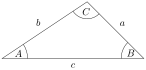
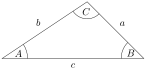
The law of sines says that the ratios of sines of angles in a triangle and the opposite sides are all constant. That’s a bit of a mouthful, maybe a math-ful will help. Consider the triangle in Figure Figure 8.1.7. The law of sines says that...
The law of cosines is really the natural extension of the Pythagorean Theorem for triangles without a right angle. Consider the triangle in Figure Figure 8.1.10. The law of cosines says that...
Unlike the Pythagorean Theorem, you don’t have to put the longest length alone on one side. It can be inputted for \(a\text{,}\)\(b\text{,}\) or \(c\text{.}\)
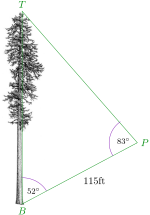
On a steep hillside somewhre in the Cascades of Oregon stands a tall Douglas Fir. The slope is from point \(B\text{,}\) at the base o the tree, to the point \(P\text{.}\) The top of the tree is at point T. Some hikers wanted to get an extimate of its height, so they took a few measurements. They measured an angle of 52° from the vertically growing tree to the hillside slope using their inclinometer on their phones. Then they measured out 115ft up the hillside to point \(P\) and measured the angle from there to be 83° from the base of the tree to the top of the tree, as shown in Figure Figure 8.1.12. Use the laws of sines or cosines to find an estimate for the height of the tree and round your answer to the nearest foot.
Imagine a triangle with sides \(a=15\text{,}\)\(c=8\text{,}\) and the angle \(C=20^\circ\text{.}\) Length \(b\) and angles \(A\) and \(B\) are unknown.
Solve for the angles and missing lengths in both triangles. Round your final answers for the angles and lengths to two digits behind the decimal place.