In this section, we’ll continue working with rational functions. We’ll examine the long-term or end behavior and see what happens when there is a common root of the numerator and denominator. We’ll then use everything we’ve learned about rational functions to graph them, as well as construct rational functions based on a given graph.
Suppose a bakery has daily fixed costs of $150. To produce a single loaf of bread costs an additional $2.75 for labor and materials.
(a)
Find a function that calculates the daily cost per loaf, \(C\) in dollars, to produce \(x\) loaves of bread.
Hint.
To find the cost per loaf, you need to divide the total costs by the number of loaves of bread.
(b)
If the bakery produce 5 loaves of bread, what is the cost per loaf?
(c)
If the bakery produce 50 loaves of bread, what is the cost per loaf?
(d)
If the bakery produce 500 loaves of bread, what is the cost per loaf?
(e)
What is happening to the per loaf cost as the number of loaves made increases?
(f)
Is there a limit to the how low the cost per loaf can go?
ExercisesPractice Exercises
1.
The function \(r(x)=\dfrac{ -6(x+5)^2(x-4) }{ (x-7) }\) does not have a horizontal asymptote. How could you change the formula for this function so that it does have a horizontal asymptote?
2.
Let \(R(x)=\dfrac{3(x+2)(x-4)}{(x+2)(x+3)}\text{.}\) Answer the following without using a calculator.
(a)
What is the domain of \(R\text{?}\)
(b)
What is the \(y\)-intercept of graph of \(R\text{?}\)
(c)
What are the \(x\)-intercepts of the graph of \(R\text{?}\)
(d)
What are the vertical asymptotes of the graph of \(R\text{?}\)
(e)
Does the graph of \(R\) have any holes? Why or why not?
(f)
If the graph of \(R\) has any holes,find the coordinates of the hole(s).
(g)
Does the graph of \(R\) have a horizontal asymptote? Why or why not?
(h)
If the graph of \(R\) has a horizontal asymptote, state its equation.
3.
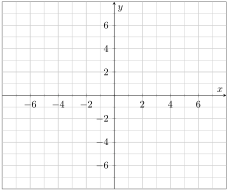
Graph \(R(x) =\dfrac{3(x+2)(x-4)}{(x+2)(x+3)}\) in Figure 3.4.1. Clearly identify all vertical asymptotes, \(x\)-intercepts, the \(y\)-intercept, any holes, and any horizontal asymptote.
An empty graph.
Figure3.4.1.\(y=r(x)\)
4.
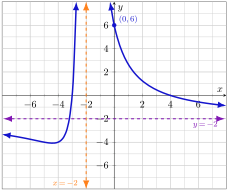
Find a possible formula for the rational function graphed in Figure 3.4.2. Take into account the vertical asymptote(s), the \(x\)-intercept(s), the \(y\)-intercept, and whether or not there is a horizontal asymptote.
Graph of a function consisting of two pieces separated by a vertical asymptote at \(x = -2\text{.}\) The graph extends sharply upward on both sides of the vertical asymptote. The graph intersects the \(x\)-axis at the points \((-3,0)\) and \((4,0)\text{.}\) The graph intersects the \(y\)-axis at the point \((0,6)\text{.}\) A horizontal asymptote is indicated at \(y = -2\text{.}\)
Figure3.4.2.\(y=r(x)\)
SubsectionDefinitions
Definition3.4.3.Holes or Removable Discontinuities.
A hole or removable discontinuity for a rational function \(r\) occurs at an \(x\)-value that is a root of both the numerator and denominator and whose multiplicity in the numerator is greater than or equal to its multiplicity in the denominator. Note: If the multiplicity of the root is greater in the denominator, then the root will create a vertical asymptote.
Example3.4.4.
There is a removable discontinuity at \(x=1\) for \(f(x)=\dfrac{(x-1)(x-5)}{(x-1)(x+3)}\) and \(g(x)=\dfrac{(x-1)^2(x-5)}{(x-1)(x+3)}\text{,}\) but \(x=1\) is a vertical asymptote for \(h(x)=\dfrac{(x-1)(x-5)}{(x-1)^2(x+3)}\text{.}\)
Definition3.4.5.Horizontal Asymptotes of Rational Functions.
Whether a rational function has is a horizontal asymptote can be determined by comparing the degrees of the numerator and denominator.
If the degree of the denominator is greater than that of the numerator, the function will have a horizontal asymptote of \(y=0\text{.}\)
If the degree of the denominator is equal to that of the numerator, the function will have a horizontal asymptote. The equation of the horizontal asymptote will be based on the ratio of the leading coefficients.
If the degree of the denominator is lessre than that of the numerator, the function will not have a horizontal asymptote.
Example3.4.6.
\(f(x)=\dfrac{6x^5-8x^3+2}{3x^6-9x+5}\) has a horizontal asymptote of \(y=0\text{.}\)
Example3.4.7.
\(g(x)=\dfrac{6x^6-8x^3+2}{3x^6-9x+5}\) has a horizontal asymptote of \(y=2\text{.}\)
Example3.4.8.
\(h(x)=\dfrac{6x^7-8x^3+2}{3x^6-9x+5}\) has no horizontal asymptote.
ExercisesExit Exercises
1.
Let \(R(x)=\dfrac{5(x+4)^2(x-2)}{2(x+4)(x+1)^2}\text{.}\)
(a)
What is the domain of \(R\text{?}\) Answer using both interval and set-builder notations.
(b)
What are the \(x\)-intercepts of the graph of \(R\text{?}\)
(c)
What are the vertical asymptotes of the graph of \(R\text{?}\)
(d)
Does the graph of \(R\) have any holes? Why or why not?
(e)
Does the graph of \(R\) have a horizontal asymptote? If it does, what is the horizontal asymptote?
2.
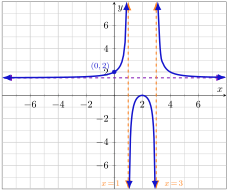
Find a possible formula for the rational function graphed in Figure 3.4.9. Take into account the vertical asymptote(s), the \(x\)-intercept(s), the \(y\)-intercept, and whether or not there is a horizontal asymptote.
Graph of a function consisting of three pieces separated by vertical asymptotes at \(x = 1\) and \(x = 3\text{.}\) The graph extends upward as it approaches \(x=1\) from the left, downward as it approaches \(x = 1\) from the right, downward as it approaches \(x = 3\) from the left, and upward as it approaches \(x = 3\) from the right, The graph intersects the \(x\)-axis at the point \((2,0)\text{.}\) The graph intersects the \(y\)-axis at the point \((0,2)\text{.}\) A horizontal asymptote is indicated at \(y = 1.5\text{.}\)
Figure3.4.9.\(y=r(x)\)
ReflectionReflection
1.
On a scale of 1-5, how are you feeling with the concepts related to the graphical behaviors of functions?