Section3.3Rational Functions and Some Key Characteristics
In this section, we’ll look at rational functions and see how the concepts we explored with polynomial functions carry over to a function that is a fraction of two polynomials.
For any real number \(k\) other tha n0, what is \(\dfrac{0}{k}\) and why?
(b)
For any real number \(k\) other tha n0, what is \(\dfrac{k}{0}\) and why?
(c)
What is the domain of \(f(x) = \dfrac{3x^2-3x-36}{2x^2+2x-60}\text{?}\)
2.
Let \(g(x) = -7(x+2)^2(x-1)^3(x+5)\text{.}\)
(a)
What are the \(x\)-intercepts and their behaviors?
(b)
What is the \(y\)-intercept?
ExercisesPractice Exercises
1.
Let \(r(x) = \dfrac{p(x)}{q(x)}\text{.}\)
(a)
What usually happens on the graph of \(r(x)\) when \(p(x) = 0\text{?}\)
(b)
What usually happens on the graph of \(r(x)\) when \(q(x) = 0\text{?}\)
2.
Let \(R(x) = \dfrac{5(x+3)(x-4)^2}{(x-2)^2(x+1)}\text{.}\)
(a)
What is the domain of \(R\text{?}\)
(b)
What is the \(y\)-intercept of \(R\text{?}\)
(c)
What are the zeros of \(R\text{?}\)
(d)
What are the \(x\)-intercepts of \(R\text{?}\)
(e)
What happens when \(x=-1\text{?}\)
(f)
What happens when \(x=2\text{?}\)
3.
When working with a rational function,
(a)
What is the behavior of a vertical asymptote that comes from a root of the denominator with odd multiplicity? Include at least two sketches of possible examples in your answer.
(b)
What is the behavior of a vertical asymptote that comes from a root of the denominator with even multiplicity? Include at least two sketches of possible examples in your answer.
4.
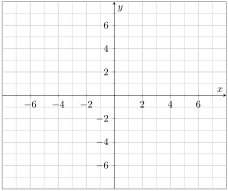
Sketch a graph of a function \(y=F(x)\) below that has:
a vertical asymptote at \(x=-2\) with even multiplicity,
a \(y\)-intercept at \((0,-2)\text{,}\)
an\(x\)-intercept at \((-4,0)\) with even multiplicity,
an\(x\)-intercept at \((3,0)\) with odd multiplicity, and
there are no other vertical asymptotes or \(x\)-intercepts.
An empty graph.
SubsectionDefinitions
Definition3.3.1.Rational Function.
A rational function is a function that can be written as the quotient of two polynomial functions, where the denominator is not 0.
where \(p\) and \(q\) are polynomial functions and \(q(x)\neq0\text{.}\)
Definition3.3.2.Vertical Asymptotes.
Given a function \(f\) and a real number \(a\text{,}\) a vertical asymptote of the graph of \(y=f(x)\) is a vertical line \(x=a\) where \(f(x)\) tends toward positive or negative infinity as \(x\) approaches \(a\) from either the left or the right. We write this as:
\begin{equation*}
\text{As } x \to a^{-}, f(x) \to \pm \infty \text{ or as } x \to a^{+}, f(x) \to \infty.
\end{equation*}
Example3.3.3.
\(x=1\) is a vertical asymptote of \(f(x)=\dfrac{x-5}{x-1}\) due to the following:
As \(x\) approaches \(x=1\) from the left, the \(y\)-values increase towards \(\infty\text{.}\) Mathematically, we write this: As \(x \to 1^{-}, f(x) \to \infty\text{.}\)
As \(x\) approaches \(x=1\) from the right, the \(y\)-values decrease towards \(-\infty\text{.}\) Mathematically, we write this: As \(x \to 1^{+}, f(x) \to -\infty\text{.}\)
Definition3.3.4.Multiplicity and Vertical Asymptotes.
The multiplicity of a root of the denominator of a rational function impacts the behavior of the vertical asymptote.
If the rational function is factored and reduced to its simplest terms, a root of the denominator with even multiplicity will produce a vertical asymptote that approaches \(\infty\) on both sides or that approaches \(-\infty\) on both sides.
If the rational function is factored and reduced to its simplest terms, a root of the denominator with odd multiplicity will produce a vertical asymptote that approaches \(\infty\) on one side and \(-\infty\) on the other.
Given a function \(f\) and a real number \(L\text{,}\) a horizontal asymptote of a graph of \(y=f(x)\) is a horizontal line \(y=L\) where \(f(x)\) tends toward \(L\) as \(x\) approaches \(\infty\) or as \(x\) approaches \(-\infty\text{.}\) We write this as:
\begin{equation*}
\text{As } x \to \infty \text{ or as } x \to -\infty, f(x) \to L.
\end{equation*}