In this section, we’ll look at the inverse of exponential functions in general, as well as focus on the inverses of a few exponential functions with commonly used bases.
Rewrite \(\sqrt[7]{2187} = 3\) as an exponential statement.
(b)
Rewrite \(2^{10}\) = 1024 as a radical statement.
2.
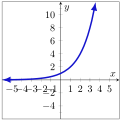
Let \(f(x) = 2^x\text{.}\) The graph of \(y=f(x)\) is in Figure 2.2.1.
Graph of the function \(f(x) = 2^x\text{.}\)
Figure2.2.1.\(f(x) = 2^x\)
(a)
Evaluate \(f(5)\text{.}\)
(b)
Evaluate \(f(-2)\text{.}\)
(c)
Solve \(f(x)=8\text{.}\)
(d)
\(f\) is a one-to-one function. How do you know and what does this mean?
(e)
What is \(f^{-1}(32)\text{?}\)
(f)
What is \(f^{-1}(\frac{1}{4})\text{?}\)
(g)
What is \(f^{-1}(1)\text{?}\)
ExercisesPractice Exercises
1.
Convert each exponential statement into a logarithmic statement.
(a)
\(3^4 = 81\)
(b)
\(5^{-2} = \dfrac{1}{25}\)
(c)
\(7^0 = 1\)
2.
Evaluate each logarithm with a calculator.
(a)
\(\log(10000)\)
(b)
\(\log_{25}(5)\)
(c)
\(\log_4\left(\dfrac{1}{64}\right)\)
3.
Let \(f(x) = 7^x\) and \(g(x) = \log_7(x)\text{.}\)
(a)
What is the domain of \(f\text{?}\)
(b)
What is the range of \(f\text{?}\)
(c)
What is the domain of \(g\text{?}\)
(d)
What is the range of \(g\text{?}\)
4.
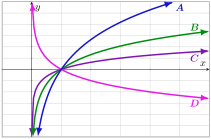
Match each function with one of the graphs below.
Four logarithmic functions graphed together. All four functions intersect the \(x\)-axis at the same point. Function D points upward at the \(y\)-axis, and downward to the right. Functions A, B, and C point downward at the \(y\)-axis, and upward to the right. To the right of the \(x\)-intercept, function A is above function B, and function B is above function C.
(a)
\(f(x) = \log_{1.7}(x)\)
(b)
\(g(x) = \log_{1/2}(x)\)
(c)
\(h(x) = \log_{1.3}(x)\)
(d)
\(j(x) = \log_3(x)\)
SubsectionDefinitions
Definition2.2.2.Logarithmic Function.
For any real number \(x \gt 0\text{,}\) a logarithm with base \(b\) of \(x\), where \(b \gt 0\) and \(b \neq 1\text{,}\) is denoted by \(\log_b(x)\) and is defined by
\begin{equation*}
y = \log_b(x) \text{ if and only if } x = b^y
\end{equation*}
Definition2.2.3.Common Logarithm.
The common logarithm, \(\log(x)\), is a logarithm with base \(10\) and satisfies
\begin{equation*}
y = \log(x) \text{ is equivalent to } 10^y = x, \text{ for } x \gt 0
\end{equation*}
Definition2.2.4.Natural Logarithm.
The natural logarithm, \(\ln(x)\), is a logarithm with base \(e\) and satisfies
\begin{equation*}
y = \ln(x) \text{ is equivalent to } e^y = x, \text{ for } x \gt 0
\end{equation*}
Definition2.2.5.Key Characteristics of Logarithmic Functions.
For an logarithmic function \(f(x) = \log_b(x)\text{,}\) with \(b \gt 0\text{,}\)\(b \neq 1\text{,}\) and \(x \gt 0\text{,}\) we have the following:
\((1,0)\) is the horizontal intercept.
There is no vertical intercept.
The domain of \(f\) is \((0, \infty)\text{.}\)
The range of \(f\) is \((-\infty, \infty)\text{.}\)
\(f\) is a one-to-one function.
The vertical asymptote is \(x = 0\text{.}\)
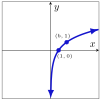
If \(b \gt 1\text{,}\) then \(f\) is an increasing function and
as \(x \to \infty\text{,}\)\(f(x) \to \infty\text{,}\) and
as \(x \to 0^+\text{,}\)\(f(x) \to -\infty\text{.}\)
Graph of a logarithmic curve, containing the points \((1,0)\) and \((b,1)\text{.}\) To the left, the curve extends sharply downward near the \(y\)-axis without crossing it. To the right, the curve continues increasing, but at a diminishing rate.
Figure2.2.6.\(y = \log_b(x), b \gt 1\)
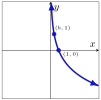
If \(0 \lt b \lt 1\text{,}\) then \(f\) is a decreasing function and
as \(x \to \infty\text{,}\)\(f(x) \to -\infty\text{,}\) and
as \(x \to 0^+\text{,}\)\(f(x) \to \infty\text{.}\)
Graph of a logarithmic curve, containing the points \((b,1)\) and \((1,0)\text{.}\) To the left, the curve extends sharply upward near the \(y\)-axis without crossing it. To the right, the curve continues decreasing, but at a diminishing rate.
to see an interactive example of a logarithmic function.
ExercisesExit Exercises
1.
(a)
Why do we call \(b\) the base of the logarithm \(\log_b(x)\text{?}\) Evaluate \(\log_2(16)\) and use this in your answer.
(b)
Evaluate \(\log_9(3)\) and then restate your logarithmic statement as an exponential statement.
(c)
For any \(b \gt 0\text{,}\) where \(b \neq 1\text{,}\) what is the domain of \(f(x) = \log_b(x)\) and why is this the domain of \(f\text{?}\)
(d)
Does a logarithmic function have a horizontal or vertical asymptote and why?
(e)
Given \(f(x) = \log_8(x)\) and \(g(x) = {-3}\cdot \log_8(x+3) - 2\text{,}\) state the sequence of transformations that takes the graph of \(y = f(x)\) to the graph of \(y = g(x)\) and also state the domain of \(g\text{.}\)
ReflectionReflection
1.
On a scale of 1-5, how are you feeling with the concepts related to the graphical behaviors of functions?