In this section, we’ll develop our understanding of functions and function notation, whether the function is presented as a set of ordered pairs, a table of values, a graph, or an equation. We’ll also learn how to evaluate a function given an input value and to solve for an input given a function’s output value.
Many of us have at least one restaurant we would love to go to for a meal. Go online and find a menu for a restaurant you’d choose to eat at.
(a)
What is the name of the restaurant and what type of food do they serve?
(b)
What is a dish you would like to get and how much does it cost?
(c)
Are there any other dishes on the menu that cost the same as your dish? If so, what are they?
(d)
If I ask you the price of any specific dish from the menu, do you know how much it costs?
(e)
If you know how much I paid for a dish, do you know exactly what I ordered based just on the price? Explain your answer.
ExercisesPractice Exercises
1.
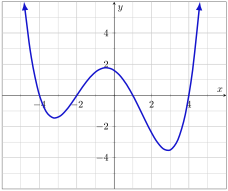
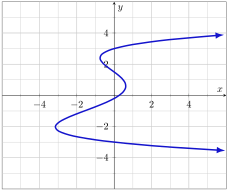
Determine if each of the following relations show \(y\) as a function of \(x\text{.}\) Explain your reasoning by referencing the definition of a function. If a relation is not a function provide a specific example why the definition was not satisfied. Assume all ordered pairs are of the form \((x,y)\text{.}\)
Graph of a smooth curve, forming the shape of a capital letter W. From left to right, it curves down through the point \((-4,0)\text{,}\) up through the point \((-2,0)\text{,}\) down through the point \((1,0)\text{,}\) and back up through the point \((4,0)\text{.}\)
(d)
Graph of a smooth curve, forming the shape of a capital letter E. From top to bottom, it curves smoothly through four points on the y-axis. There are arrows at the top and bottom, indicating that the ends of the line both extend to the right of the grid.
2.
(a)
Let \(y=g(x)\) be defined as the set of \((x,y)\) ordered pairs:
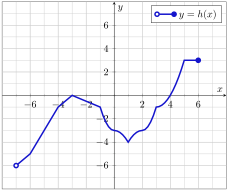
Graph of a continuous, irregular curve. It travels through the points \((-7,-6)\text{;}\)\((-6,-5)\text{;}\)\((-4,-1)\text{;}\)\((-3,0)\text{;}\)\((-1,-1)\text{;}\)\((0,-3)\text{;}\)\((1,-4)\text{;}\)\((2,-3)\text{;}\)\((3,-1)\text{;}\)\((4,0)\text{;}\)\((5,3)\text{;}\)\((6,3)\text{.}\) At the point \((-7,-6)\) there is an empty circle. At the point \((6,3)\) there is a filled circle.
(i)
Find \(h(-4)\text{.}\)
(ii)
Solve \(h(x)=-3\text{.}\)
(c)
Let \(f(x) = x^2 - 3\text{.}\)
(i)
Find \(f(-4)\text{.}\)
(ii)
Solve \(f(x)=46\text{.}\)
SubsectionDefinitions
Definition1.1.1.Relation.
A relation is a set of \((x,y)\) ordered pairs.
The variable of \(x\) is called the independent variable or input variable. Each individual \(x\)-value is referred to as a input or input value.
The variable of \(y\) is called the dependent variable or output variable. Each individual \(y\)-value is referred to as a output or output value.
A function is a relation where each possible input value is paired with exactly one output value. We say, “The output is a function of the input,” and often write this algebraically as \(y = f(x)\text{.}\)
The Domain of a relation or function is the set of all possible input values. The Range of a relation or function is the set of all possible output values.
the domain of the function is \(\{0,4,1,9,16\}\) and the range of the function is \(\{-2,0,-1,1,2\}\text{.}\)
Definition1.1.8.Vertical Line Test.
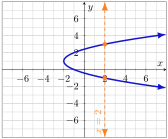
If a vertical line can be drawn that intersects the graph more than once, the graph is not the graph of a function with \(x\) as the independent variable and \(y\) as the dependent variable.
Example1.1.9.
A graph of a parabola opening up to the right. A vertical line is drawn at \(x=2\text{,}\) intersecting the parabola at \((2,3)\) and \((2,-1)\text{,}\) demonstrating the vertical line test.
Figure1.1.10.Does Not Pass
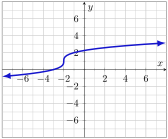
A graph of a smooth curve that travels from left to right, passing through the points \((-6,-1)\text{;}\)\((-3,0)\text{;}\)\((-2,1)\text{;}\)\((-1,2)\text{;}\)\((2,3)\text{;}\) and \((7,4)\text{.}\) There are no \(x\)-values for which a vertical line can be drawn that passes through the graph more than once.
Figure1.1.11.Passes
ExercisesExit Exercises
1.
(a)
What is the definition of a function?
(b)
What are two examples of functions that you use in your daily life outside of school? Explain how these are functions, referencing the definition of a function.
(c)
What do you look for in the graph of a relation to determine if the graph is the graph of a function or not? Fully explain your answer.
2.
If \(f(x) = 2x^2 - 7x\text{,}\) evaluate \(f(-3)\text{.}\)
3.
If \(g(x) = x^2 + 6x\text{,}\) solve \(g(x)=16\text{.}\)
ReflectionReflection
1.
On a scale of 1–5, how are you feeling with the concepts related to the graphical behaviors of functions?