In this section, we’ll focus on the short-term behaviors of polynomial functions and the location and behavior of the \(x\)-intercepts can be identified from their factored algebraic form. We’ll then use this knowledge to both graph polynomial functions, as well as construct polynomial functions based on a graph.
Describe the end behavior of the graph of \(y=f(x)\text{.}\)
(b)
What are the \(x\)-intercept(s) of \(y=f(x)\text{?}\)
(c)
What is the \(y\)-intercept of \(y=f(x)\text{?}\)
(d)
At most how many turning points does the graph of \(y=f(x)\) have?
2.Preparation 2.
Let \(g(x) = -2(x+3)^2(x-2)(x+1)^3\)
(a)
Describe the end behavior of the graph of \(y=g(x)\text{.}\)
(b)
What are the \(x\)-intercept(s) of \(y=g(x)\text{?}\)
(c)
What is the \(y\)-intercept of \(y=g(x)\text{?}\)
(d)
At most how many turning points does the graph of \(y=g(x)\) have?
ExercisesPractice Exercises
1.
Let \(f(x) =\frac{1}{2}(x-2)(x+1)^2(x-4)\text{.}\)
(a)
What is the end behavior of the graph of \(y=f(x)\text{?}\) Why?
(b)
\item What are the \(x\)-intercepts and their behaviors? Why?
(c)
\item What is the \(y\)-intercept?
(d)
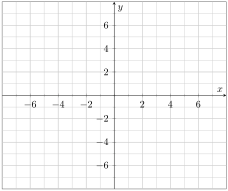
Sketch a graph of \(y=f(x)\) in the grid below.
An empty graph.
2.Practice 2.
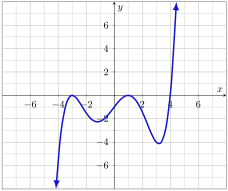
Given in Figure 3.2.1 is the graph of the polynomial \(g\text{.}\)
Graph of a polynomial. Extending downward to the left, the curve comes up from below and appears to bounce off of the \(x\)-axis at the point \((-3,0)\text{,}\) intersects the \(y\)-axis at \((0,-1)\text{,}\) bounces off the \(x\)-axis again at the point \((1,0)\text{,}\) then passes directly through the \(x\)-axis at \((4,0)\text{,}\) extending upward to the right.
Figure3.2.1.\(y=g(x)\)
(a)
Based on the end behavior and other characteristics of the graph of \(y=g(x)\text{,}\) what are the possibilities for the degree of \(g\text{?}\)
(b)
Based on the end behavior of the graph of \(y=g(x)\text{,}\) is the leading coefficient of \(g\) positive or negative?
(c)
Based on the \(x\)-intercepts, what are the linear factors of \(g\) and their powers?
(d)
What is a possible formula for the function \(g\text{?}\)
SubsectionDefinitions
Definition3.2.2.Multiplicity.
The multiplicity of a factor is the number of times that factor occurs in the factored version of the polynomial. We will also refer to the multiplicity of the zero for the zero associated with this factor.
The sum of the multiplicities of the real roots for a polynomial function is less than or equal to the degree of the polynomial.
Example3.2.3.
For \(f(x) = 3(x-5)(x+4)^2\text{,}\) the multiplicity of \(5\) is one and the multiplicity of \(-4\) is two.
Definition3.2.4.Even Multiplicity.
When a root or zero has even multiplicity, then the graphical behavior at the associated \(x\)-intercept is that the graph will touch, but not cross, the \(x\)-axis at that \(x\)-intercept.
Definition3.2.5.Odd Multiplicity.
When a root or zero has odd multiplicity, then the graphical behavior at the associated \(x\)-intercept is that the graph will cross over the \(x\)-axis at that \(x\)-intercept.
When the multiplicity of a root is one, the graph will cross through the \(x\)-intercept in a somewhat linear manner.
When the multiplicity of a root is a larger odd number, the graph will cross through the \(x\)-intercept by flattening out as it crosses.
to see an interactive example how the multiplicity of a root of a polynomial function impacts the behavior of the related \(x\)-intercept.
ExercisesExit Exercises
1.
(a)
What is the difference between a zero and an \(x\)-intercept of a polynomial function?
(b)
How is the factored version of a polynomial function useful when graphing the function? What does the factored version help us to be able to quickly identify?
(c)
How is the expanded (non-factored) version of a polynomial function useful when graphing the function? What does the non-factored version help us to be able to quickly identify?
(d)
If the graph of a polynomial function touches, but doesn’t cross, the \(x\)-axis at a point \((k,0)\text{,}\) what do we know about the factored form of that function?
2.Exit 2.
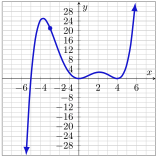
Identify a possible formula for the polynomial function \(F\) whose graph is in Figure 3.2.7. There is a point on the graph at \((-3,21)\text{.}\)
Graph of a polynomial. The curve extends downward to the left, passes directly through the \(x\)-axis at \((-5,0)\text{,}\) curves downward through the point \((-3,21)\text{,}\) bounces off the \(x\)-axis at \((0,0)\text{,}\) bounces off of the \(x\)-axis again at \((4,0)\text{,}\) then extends upward to the right.
Figure3.2.7.\(y=f(x)\)
ReflectionReflection
1.
On a scale of 1-5, how are you feeling with the concepts related to the graphical behaviors of functions?