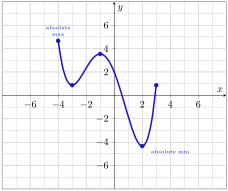
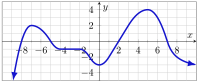
Definition 1.2.4. Domain and Range.
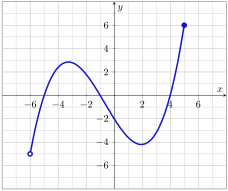
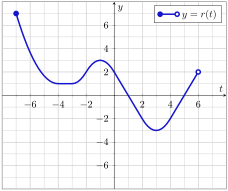
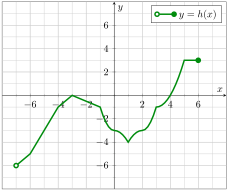
The domain of a function is the set of all possible input values for the function.
The range of a function is the set of all possible output values for the function.
The domain and range are commonly stated using interval notation or set-builder notation.
Example 1.2.5. Domain and Range.
View this Desmos graphhttps://tiny.cc/111Z-DomRang
to see an interactive example of these definitions.
Definition 1.2.6. Positive and Negative.
A function \(f\) is positive if the output values are greater than \(0\text{.}\) \(f\) is positive when \(f(x) \gt 0\text{.}\)
A function \(f\) is negative if the output values are less than \(0\text{.}\) \(f\) is negative when \(f(x) \lt 0\text{.}\)
Example 1.2.7. Positive and Negative.
View this Desmos graphhttps://tiny.cc/111Z-PosNeg
to see an interactive example of these definitions.
Definition 1.2.8. Increasing, Decreasing, and Constant.
Let \(f\) be a function that is defined on an open interval \(I\text{,}\) with \(a\) and \(b\) in \(I\) and \(b \gt a\text{.}\)
\(f\) is increasing on \(I\) if \(f(b) \gt f(a)\) for all \(a\) and \(b\) in \(I\text{.}\) In other words, as you move left-to-right on the interval \(I\text{,}\) your \(y\)-values increase.
\(f\) is decreasing on \(I\) if \(f(b) \lt f(a)\) for all \(a\) and \(b\) in \(I\text{.}\) In other words, as you move left-to-right on the interval \(I\text{,}\) your \(y\)-values decrease.
\(f\) is constant on \(I\) if \(f(b) = f(a)\) for all \(a\) and \(b\) in \(I\text{.}\) In other words, as you move left-to-right on the interval \(I\text{,}\) your \(y\)-values do not change.
Example 1.2.9. Positive and Negative.
View this Desmos graphhttps://tiny.cc/111Z-IncDec
to see an interactive example of these definitions.
Definition 1.2.10. Local Minimum or Maximum.
Given a function \(f\) that is defined on an open interval \(I\text{,}\) with \(c\) in \(I\text{.}\)
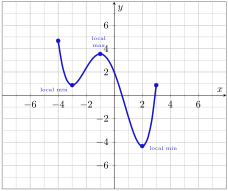
\(f\) has a local maximum at \(x = c\) if \(f(c) \geq f(x)\) for all \(x\) in \(I\text{.}\) The local maximum value of \(f\) is the output \(f(c)\text{.}\)
\(f\) has a local minimum at \(x = c\) if \(f(c) \leq f(x)\) for all \(x\) in \(I\text{.}\) The local minimum value of \(f\) is the output \(f(c)\text{.}\)
Definition 1.2.13. Absolute Minimum or Maximum.
\(f\) has an absolute maximum at \(x = c\) if \(f(c) \geq f(x)\) for all \(x\) in the domain of \(f\text{.}\) The absolute maximum value of \(f\) is the output \(f(c)\text{.}\)
\(f\) has an absolute minimum at \(x = c\) if \(f(c) \leq f(x)\) for all \(x\) in the domain of \(f\text{.}\) The absolute minimum value of \(f\) is the output \(f(c)\text{.}\)