1.
Suppose the following graph represents the function \(A\) which gives the air temperature (in °F above 65°F) in a classroom \(t\) hours after midnight each weekday.
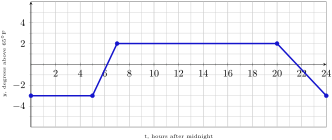
Graph of a function depicting air temperature in a classroom. The horizontal axis is labeled "\(t\text{,}\) hours after midnight" and is shown for \(t\) between 0 and 24. The vertical axis is labeled "\(y\text{,}\) degrees above 65°F" and is shown from -6 to 6. The graph begins at \((0,-3)\text{,}\) is constant until the point \((5,-3)\text{,}\) increases linearly to the point \((7,2)\text{,}\) is constant until the point \((20,2)\text{,}\) then decreases linearly to the point \((24,-3)\text{.}\)
(a)
Let \(W\) be a new function that has the same schedule as the room used by \(A\text{,}\) but is for a room that is always two degrees warmer than the room used by \(A\text{.}\) In Figure 1.6.1, sketch the graph of the function \(W\text{.}\)
(b)
What expression could we use for \(W\) to represent the function used to create the graph for the room that is always two degrees warmer than the room used for \(A\text{?}\)
(c)
If we were to vertically shift the graph of \(y=A(t)\) down by one unit in the \(y\) direction to create a new function \(C\text{,}\) what would that mean in the context of the temperature of the room and what expression could we use to represent \(C\text{?}\)


