Section1.5Algebraic Combinations of Functions and Function Composition
In this section, we’ll learn about several ways we can combine funcitons algebraically, as well as use the output from one function as the input for another. As we’ve done before, we’ll investigate these ideas with functions presented as graphs, as tables, and as formulas.
Suppose it costs a bakery $3,000 for rent and utilities each month and each loaf of bread costs $2.15 to produce. The bakery sells each loaf of bread for $6.49.
(a)
Find a function \(C\) that calculates the total cost (in dollars) each month to produce \(x\) loaves of bread.
(b)
Find a function \(R\) that calculates the total revenue (in dollars) each month from selling \(x\) loaves of bread.
(c)
Find a function \(P\) that calculates the profit (in dollars) from producing and selling \(x\) loaves of bread each month. (Note: The profit is the difference between the revenue and costs.)
2.
The function \(r=f(t)=0.35t\) gives the radius (in inches) of the circular pattern formed when a drop of water hits a pond \(t\) seconds after the drop of water hits the pond’s surface. The function \(a = g(r) = \pi r^2\) gives the area of a circle (in square inches) when the circle has a radius of \(r\) inches.
(a)
How would you determine the area of the circle 9 seconds after a water drop lands on the pond?
ExercisesPractice Exercises
1.
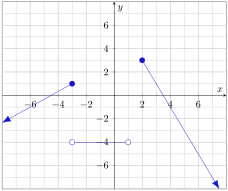
Let \(f(x) = x^2-4x\text{,}\)\(g(x) = \sqrt{3x+1}\text{,}\)\(h\) be defined by Table 1.5.1, and \(k\) defined by Figure 1.5.2.
\(x\)
\(h(x)\)
\({-4}\)
\({8}\)
\({-2}\)
\({1}\)
\({1}\)
\({3}\)
\({2}\)
\({6}\)
\({4}\)
\({-7}\)
\({8}\)
\({-5}\)
Table1.5.1.\(h(x)\)
Graph of a piecewise function consisting of three linear pieces. One line extends off the graph to the left, passes through the point \((-6,-1)\text{,}\) and ends with a filled circle at \((-3,1)\text{.}\) One line begins with an empty circle at \((-3, -4)\) and ends with an empty circle at \((1,-4)\text{.}\) One line begins with a filled circle at \((2,3)\text{,}\) passes through the point \((3,1)\text{,}\) and extends off the graph to the right.
Figure1.5.2.\(y=k(x)\)
(a)
Evaluate the following:
\(\displaystyle (f-k)(-3)\)
\(\displaystyle (g \cdot h)(1)\)
(b)
Evaluate the following:
\(\displaystyle (k \circ g)(5)\)
\(\displaystyle (f \circ h)(8)\)
2.
Let \(F(x) = \dfrac{x+5}{x-3}\text{,}\)\(G(x) = x^2 - 4\text{,}\) and \(H(x) = \sqrt{2x+19}\text{.}\)
State the domain of the following functions:
(a)
\(\dfrac{H}{G}\)
(b)
\(F \circ H\)
SubsectionDefinitions
Definition1.5.3.Algebraic Combinations of Functions.
Two functions \(f\) and \(g\) can be combined using the operations of addition, subtraction, multiplication, or division as follows:
\({f+g}\) is defined for all values of \(x\) in the domain of both \(f\) and \(g\) as \((f+g)(x) = f(x) + g(x)\text{.}\)
\({f-g}\) is defined for all values of \(x\) in the domain of both \(f\) and \(g\) as \((f-g)(x) = f(x) - g(x)\text{.}\)
\(f \cdot g\) is defined for all values of \(x\) in the domain of both \(f\) and \(g\) as \((f\cdot g)(x) = f(x) \cdot g(x)\text{.}\)
\(\dfrac{f}{g}\) is defined for all values of \(x\) in the domain of both \(f\) and \(g\) and where \(g(x) \neq 0\) as \(\left(\dfrac{f}{g}\right)(x) = \dfrac{f(x)}{g(x)}\text{.}\)
Definition1.5.4.Function Composition.
The composition of functions, \(f \circ g\) occurs when the output of one function \(g\) is used as the input of another function \(f\) and is defined as \((f \circ g)(x) = f(g(x)\text{.}\)
The domain of \(f \circ g\) is all values of \(x\) in the domain of \(g\) where the values of \(g(x)\) are in the domain of \(f\text{.}\)
Note that \(f \cdot g\) is used for the product of two functions, while \(f \circ g\) is used for composition.
ExercisesExit Exercises
1.
Answer the following in general for two functions \(f\) and \(g\text{.}\)
(a)
What is meant by \((f + g)(6)\text{?}\) Explain both algebraically, as well as in written words.
(b)
For two functions \(f\) and \(g\text{,}\) how do you find the domain of \(f + g\text{,}\)\(f-g\text{,}\) or \(f\cdot g\text{?}\) \\
What else do you need to consider for \(\dfrac{f}{g}\text{?}\)
(c)
What is meant by \((f \circ g)(-4)\text{?}\) Explain both algebraically, as well as in written words.
(d)
In general, does the order of composition matter? Does \((f \circ g)(x)\) yield the same thing as \((g \circ f)(x)\text{?}\)
2.
Let \(f(x) = x^2 + 7x\text{,}\)\(g(x) = \sqrt{5x-1}\text{,}\) and \(h(x) = \dfrac{x+1}{x-2} \text{.}\)
(a)
Evaluate \((g-f)(10)\text{.}\)
(b)
Evaluate \((h \circ f)(x)\)
ReflectionReflection
1.
On a scale of 1-5, how are you feeling with the concepts related to the graphical behaviors of functions?